By Zehra Topbas
On a crisp evening in January 1912, 12 Italian immigrant men gathered in a small wooden building behind Angelo Maisano’s store at 821 Regent St. to play cards and talk about the day’s problems.

Over 100 years later, this gathering formed what became the Italian Workmen’s Club. One of the oldest continually operating Italian organizations in the country, the club serves as a place where Americans of Italian heritage can reconnect with the culture of their ancestors.
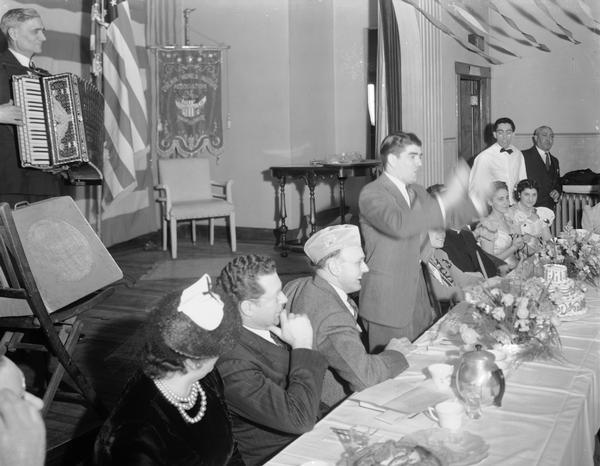
“The workmen’s club was originally put together as a mutual aid society to help members. Years ago, if you got sick, and you couldn’t work, you got $1 a day”, said George Fabian, an active member of the club. However, the club was also a social center — a place to relax, speak Italian, host community dinners, and celebrate marriages.
The majority of the club’s founders had been friends back in Sicily, coming from poor regions in the surrounding areas of Palermo.
The journey to America was long and filled with unexpected challenges. Catherine LeTourneau, now 104 years old, recounts the story of her parents coming to America and settling in Madison. “They came in 1912 on the SS Canada. They couldn’t speak English. It was rough,” LeTourneau said.
The Italians that arrived in Madison were hard-workers who sought the opportunity to put their skills to work to earn money. “I never saw my dad sit down. He would come home and eat and then go fishing, or go work on the house,” LeTourneau said.
As immigrants arrived in Madison, they bought small houses in a 52-acre triangle of land on the city’s west side bordered roughly by West Washington, Park and Regent Streets — a part of town known as the Greenbush.
The young men and women born after their parents arrived interacted more with the community outside Greenbush. Many attended local schools and spent time at the Neighborhood House, a community center for people of all backgrounds in Madison. “We spent our time there after supper. We would go to the neighborhood house and we played basketball,” a member of the Italian Workmen’s Club said. “That’s where our parents would go and had classes to become citizens,” Fabian added. “The neighborhood house was a godsend,” LeTourneau said.
In 1934, the wives of the IWC members organized into a women’s auxiliary to facilitate planning for social events. Catherine LeTourneau was among one of the founding members.
In November of 1968, the city of Madison had approved a $1 million bond issue for urban renewal.
Its goal was to eliminate poor housing, traffic congestion, challenges to commercial and industrial growth, and deterioration of neighborhoods and the city. “We were there until it was taken away,” LeTourneau said. “The boys had all gone into service. They had done their time. Still, they kicked us out of the neighborhood which was not fair”.
“Broke a lot of elders’ heart…a lot of them elders didn’t drive, spoke broken, everything they had was within walking distances. They didn’t know anything about supermarkets’ ‘ John Caliva, another IWC member, said. “Paulie’s mother, till the day she died, she cried every day because they moved her out.”
The 1970s brought a number of changes to the IWC as the club was forced to look beyond the Greenbush. “While we try to keep up the tradition, it’s very difficult. In the beginning, you had to be all Italian. And then, we started to integrate, so to speak. I mean, most people, a lot of our generation, we didn’t marry Italian girls. As generations continue, it becomes diluted,” Fabian said.

Despite the generations that have passed through the clubhouse, the IWC still remains a vibrant part of the Italian community in Madison for many. The relationships and friendships that began in the Greenbush have persisted through the decades as generation after generation carry out traditions.
Today, members of the old Greenbush community still gather to recount the good old days — whether that be at the clubhouse or at Fabian’s old Park Street Shoe Repair Shop.
 Italians in Madison